The Supreme Court of India has overturned an order by the National Green Tribunal (NGT) that halted construction activities at Auroville in Chennai. The court emphasized the need for a "golden balance" between the right to development and the right to a clean environment, upholding the principle of sustainable development. The decision comes as a victory for the Auroville Foundation, which had challenged the NGT order, and highlights the ongoing debate about balancing environmental concerns with economic growth in India.
A three-judge bench headed by Chief Justice Justice (CJI) Sharad Arvind Bobde said that a larger bench will decide the pleas filed by 35 petitioners challenging Centre's decision.

The comedian has failed to appear before the Mumbai police for questioning despite three summons issued to him.
The Supreme Court of India has expressed concern over the protracted trials in heinous offences related to Maoist activities, stating that indefinite incarceration violates the right to liberty under Article 21 of the Constitution. Two separate benches of the court granted relief to two accused, citing the delayed trials. One bench expedited the trial of a man accused of transporting ammunition for a banned organization, while the other granted bail to a man accused of transporting materials for Naxal activities. The court emphasized the importance of speedy trials and suggested the establishment of special courts to handle Maoist-related cases, aiming to expedite proceedings. The court also criticized the practice of examining an excessive number of witnesses, which can lead to indefinite delays in the conclusion of trials.

He asserted that the concept of 'one flag, one prime minister, one Constitution' was not a political slogan and the Bharatiya Janata Party firmly believes in the principle and finally implemented it with regard to Jammu and Kashmir.

The Supreme Court of India on Wednesday postponed the hearing of its five-judge Constitution bench on the legal issue concerning the scope of legislative and executive powers of the Centre and Delhi government over control of services in the national capital.

The CBI has filed a case against six Jammu and Kashmir police officials for allegedly torturing a fellow constable in custody. The case was registered following a Supreme Court order.

Tamil Nadu Governor R N Ravi has sparked controversy by asking students at a government-aided college in Madurai to chant "Jai Shri Ram". The State Platform for Common School System-Tamil Nadu (SPCSS-TN) has demanded his removal, alleging that he violated his oath of office and secular principles. The group claims Ravi's actions were against the Constitution, which outlines India as a secular country and emphasizes the importance of upholding secular values in education. The incident follows a recent Supreme Court ruling that overruled Ravi's decision to withhold 10 Bills passed by the Tamil Nadu government, highlighting ongoing tensions between the Governor and the state administration.
In a significant verdict, the Supreme Court by a majority of 7:2 on Tuesday held all private properties cannot form part of "material resources of the community" empowering states to take them over for distribution to serve "common good" under the Constitution.

The Supreme Court of India expressed shock and disappointment at the Indian government's failure to implement the Dam Safety Act, enacted in 2021. The court highlighted the lack of progress in constituting a national committee for dam safety and formulating regulations despite the law's provisions. The case pertains to the safety of the Mullaperiyar Dam, a 130-year-old structure in Kerala, which is controlled by Tamil Nadu. The court has ordered the government to take immediate action and seek assistance from the Attorney General in this matter.

The matter is pending for a long time and it be listed before the appropriate bench on September 10, the bench said in a hearing conducted through video conferencing.
The Supreme Court of India will likely hear a batch of petitions challenging the constitutional validity of the Waqf (Amendment) Act, 2025 on April 15. The Act, which came into force on April 8, has been met with widespread criticism from various stakeholders, including politicians, the All India Muslim Personal Law Board (AIMPLB), and Jamiat Ulama-i-Hind. They argue that the law is discriminatory and violates the fundamental rights guaranteed under Articles 25 and 26 of the Constitution. The petitions allege that the amendments give the government more control over the administration of Waqf, effectively sidelining the Muslim minority from managing their own religious endowments.
The court also directed YouTube and a Marathi news channel to forthwith remove the video of the press conference and also restrained them from uploading it in future.
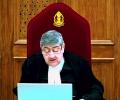
People must have tolerance for each other's opinion at a time when the tolerance level has gone down internationally, Supreme Court judge Justice Sanjay Kishan Kaul said on Friday.

Rule of law prevents a government, brought to power by the strength of ballots, from betraying the trust of citizens and "lapsing into a government of caprice, nepotism and finally despotism", the Supreme Court said on Thursday.

Amid widespread outrage and criticism, and opposition demand for a CBI probe, Chief Minister M K Stalin on Tuesday ordered transferring to the central agency, the investigation into death of Ajithkumar (29), who was picked up by a "special team" for interrogation in connection with a theft case.

The Supreme Court said on Tuesday it has to be alive to the fact that the concept of marriage has evolved and must accept the basic proposition that marriage itself is entitled to constitutional protection as it is not just a matter of statutory recognition.

The Calcutta High Court has ordered the formation of a three-member committee to identify and rehabilitate people displaced by violence during protests over the Waqf (Amendment) Act in Murshidabad district. The court also extended the deployment of Central Armed Police Force (CAPF) in the area. The committee will consist of officials from the National Human Rights Commission (NHRC), West Bengal Human Rights Commission (WBHRC), and the State Legal Services Authority (SLSA). It will be responsible for identifying displaced persons, assessing damage to properties, collecting FIR data, facilitating FIR filing, and overseeing the well-being of displaced individuals. The state government has been instructed to provide necessary infrastructure to the committee and report on its progress by May 15. The court also directed the state to formulate a rehabilitation scheme for displaced persons, including the construction of damaged houses and shops, compensation for lost livelihoods, and protection for families of those who died in the violence.

The Supreme Court on Thursday referred to a Constitution bench a bunch of petitions arising out of certain orders passed by the Gauhati high court in the ongoing political battle in Arunachal Pradesh.

'The ruling does not automatically mean that your house can be taken away, but suppose it blocks an expressway or a highway or such essential development, then it can be taken away as long as there is a law to support that action.'

The Supreme Court said on Monday it will have to constitute a bench to hear a plea against the collegium system of appointment of judges to the apex court and high courts.

The Supreme Court of India began hearing a batch of petitions challenging the constitutional validity of the Waqf (Amendment) Act, 2025. The bench, led by Chief Justice Sanjiv Khanna, asked both sides to address whether the court should entertain the petitions or relegate them to the high court. The hearing is underway with senior advocate Kapil Sibal arguing for the petitioners. The act, which was passed by Parliament following heated debates, has been challenged by various parties including AIMIM leader Asaduddin Owaisi, All India Muslim Personal Law Board (AIMPLB), and Jamiat Ulama-i-Hind.

Sources said the Congress may consider opposing the bill when it is introduced in Parliament. The Aam Aadmi Party, which is in power in Delhi, has been seeking the support of various political parties on the matter.

The "opaque" electoral bonds scheme for funding political parties will "destroy democracy" as it promotes corruption and does not allow a level playing field between the ruling and opposition parties, the petitioners challenging the validity of the scheme told the Supreme Court, which on Tuesday observed election funding was a "complicated issue".
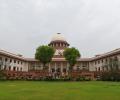
The Indian government has defended the Waqf (Amendment) Act, 2025 in the Supreme Court, arguing that there cannot be a blanket stay on the law as there is a presumption of its constitutionality. The Centre countered the pleas challenging the law's validity, asserting that the amendments were undertaken after a comprehensive study by a parliamentary panel. The government also highlighted the "reported misuse" of earlier provisions and the increase in waqf land, claiming that over 20 lakh hectares were added after 2013.

The Centre told the Supreme Court on Wednesday any constitutional declaration made by it on pleas seeking legal validation for same-sex marriage may not be a "correct course of action" as the court will not be able to foresee, envisage, comprehend and deal with its fallout.

A bench comprising Justices J B Pardiwala and R Mahadevan said, "He (the governor) seems to have adopted his own procedure. He says, 'I withhold assent, but I will not ask you to reconsider the bill'. It does not make sense to keep withholding assent and not send it to the legislature, thereby frustrating the provision of Article 200."

The BJP lawmaker sparked a row when he said, "(the) Supreme Court is taking the country towards anarchy" and that "Chief Justice of India Sanjiv Khanna is responsible for the civil wars taking place in the country".
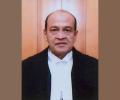
The 56-year-old judge, enrolled as an advocate in 1992, was appointed as an additional judge of the Allahabad high court on October 13, 2014 and took oath as a permanent judge of that court on February 1, 2016.

In a setback to the Centre, the Supreme Court on Thursday held that states have the legislative competence to impose taxes on mines and minerals-bearing lands under the Constitution.

A bench of Justices Surya Kant and N Kotiswar Singh deferred the hearing on Shah's plea after his counsel and senior advocate Maninder Singh made a request.

The law prohibits conversion of any place of worship and provides for the maintenance of the religious character of any place of worship as it existed on August 15, 1947.
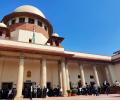
A bench of Justices Sanjiv Khanna and Dipankar Datta issued notice to the Centre on a plea filed by an NGO, Association for Democratic Reforms, and listed the matter along with other pending petitions on the issue for hearing in April.

The Supreme Court on Wednesday said it will commence hearing on October 17 to examine the constitutional validity of Section 6A of the Citizenship Act relating to illegal immigrants in Assam.
The Supreme Court of India has reprimanded the central government for failing to implement a cashless treatment scheme for road accident victims. The court expressed its concern over the delay in formulating the scheme, which is designed to provide immediate medical care to accident victims within the crucial "golden hour." The court highlighted that despite a statutory provision requiring the scheme's implementation, the government has not taken any action, prompting the court to intervene. The court also criticized the General Insurance Council (GIC) for raising objections to the scheme and delaying its implementation. The court has now directed the government to notify the scheme within a week and has scheduled a hearing on the matter for May 13.
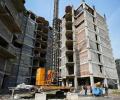
Observing an "unholy nexus" between the banks and developers to dupe homebuyers, the Supreme Court on Tuesday directed the CBI to register seven preliminary enquiries against builders in NCR, including Supertech Limited.

The Supreme Court of India has criticized the Uttar Pradesh government and Prayagraj Development Authority for the demolition of homes in the city, calling the actions "inhuman and illegal." The court ordered the authority to pay Rs 10 lakh compensation each to the homeowners, stating that the demolitions were carried out in a "high-handed" manner without following due legal process. The petitioners, whose homes were demolished, argued that the state government wrongly believed the land belonged to gangster-politician Atiq Ahmed. The Allahabad High Court had previously rejected their plea challenging the demolition.

The order came on a batch of petitions challenging the constitutional validity of the Aadhaar scheme.

The pleas raise the legal question of whether a husband enjoys immunity from prosecution for the offence of rape if he forces his wife, who is not a minor, to have sex.
Justice Gavai's comment came while the apex court bench, also comprising Justice Augustine George Masih, was considering a fresh plea seeking an inquiry into the recent violence in West Bengal during anti-Waqf law protests.
